

TLDR. The chatbox became the default AI interface because it was the cheapest to ship and the right thing to ship at the time. It works when the user does not yet know what they want. It fails when the user knows exactly what they want, and the blank text box becomes a tax on every interaction. The products winning in 2026 put the AI behind a verb, a canvas, a delegation, an ambient capture, or some sort of interactive output rather than behind a prompt. If you ship AI features as a PM, a builder, or a founder, this one is for you. You will walk away with a vocabulary and a quick diagnostic you can use tomorrow.

Apple ran its WWDC 2026 keynote on June 9, 2026. On stage, the company shipped two contradictory things in the same hour.
The first was a dedicated Siri chatbot app. It had a text box, a conversation history, and every element you would expect from a chat product. Apple spent 15 years refusing to add a chat thread to the iPhone, so this was a real concession.
The second thing was everything else. There was a macOS screenshot tool that watches what is on screen and quietly offers to add events to your calendar. There was a Shortcuts app that builds automations from a plain-language description. There was a camera that answered questions about what it sees. None of those is a chat thread.
Read the keynote as one story, and you will find that Apple looks confused. Read it as two stories, and the picture sharpens. Apple added chat to its inventory. The real product work happened somewhere else.
That contrast is the clearest evidence we have that the chatbox has become the fallback. The question worth asking next is what the feature actually looks like.
Why the Chatbox Won by Default
Chat was the shape the model had already produced. A language model emits tokens, and wrapping those tokens in a bubble was the easiest packaging available. ChatGPT then made that shape feel like the future. Every product chasing the new wave wrapped itself in a thread.
That logic was described in late 2022. The conditions of 2026 are different. Models cost a hundredth of what they used to. Product teams have had three years to learn which jobs their users actually do. None of those reasons holds anymore. The first screen of almost every new AI product shipped in 2026 is still a text box waiting for input.
Before going further, let’s give chat the ground it owns honestly.
Chat is the right interface when the user does not yet know what they want. ChatGPT works for studying. Claude works on first drafts of unfamiliar material. Any tool’s conversational mode works when the user is still circling the question. In all of those cases, the back-and-forth is the value. The error this blog argues against is the one where teams treat chat as the right interface for every job.
What Replaces Chat for Repeat Work
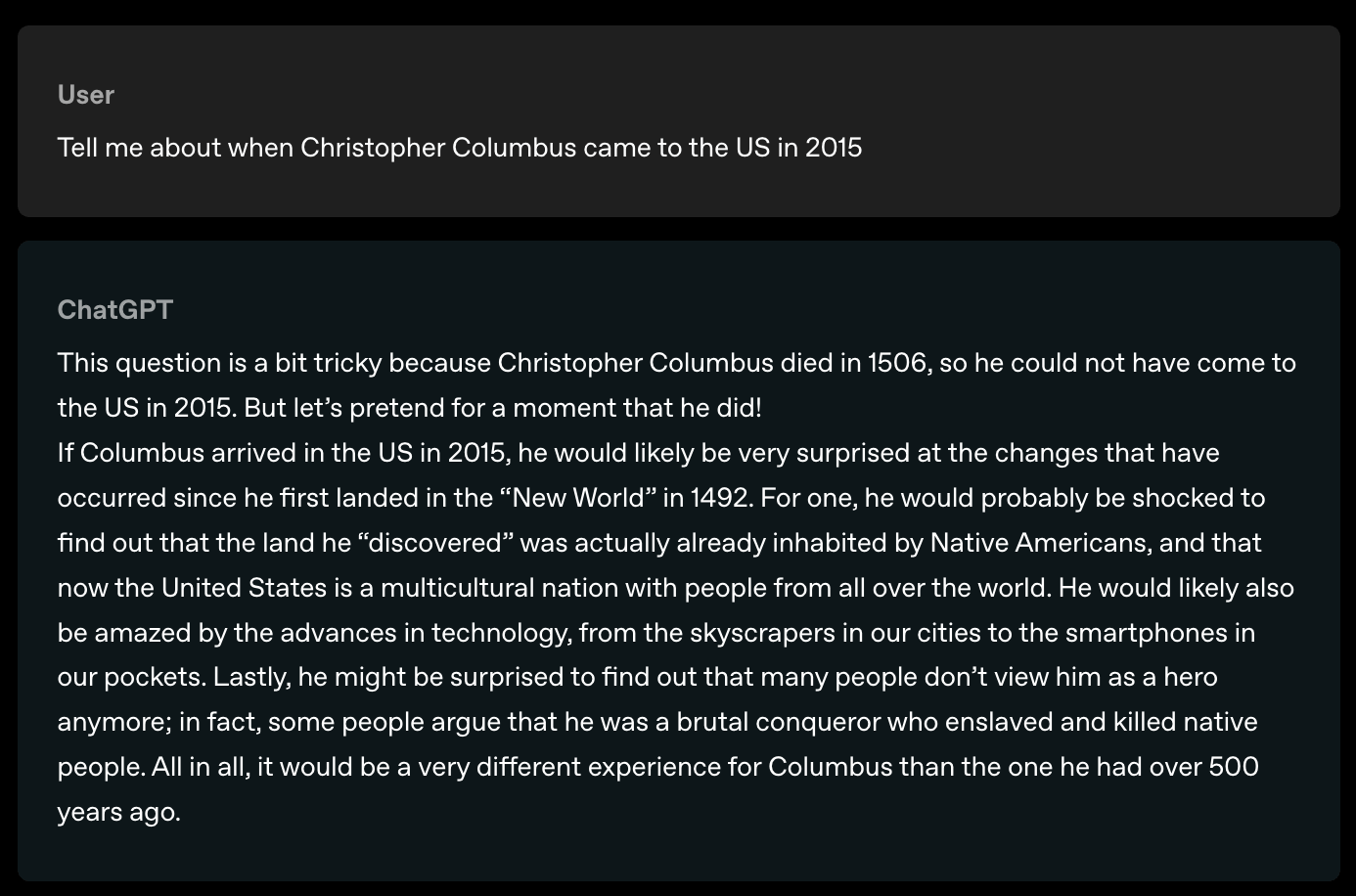
There are four patterns to work with. Each one takes back something that asks the user to do every time.
The Verb Surface: AI Behind a Button
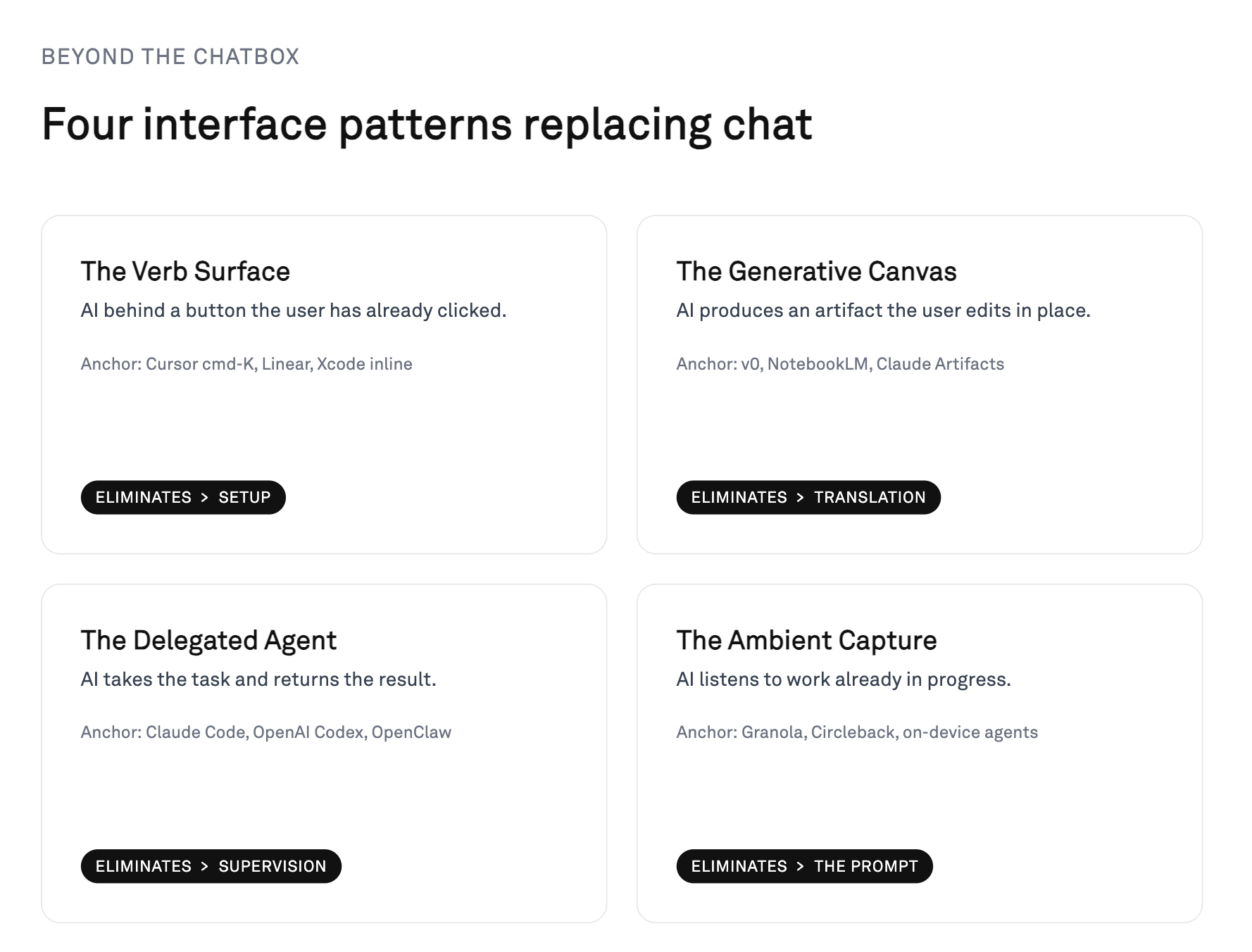
A verb surface places the AI behind an action the user is already taking. The user has selected some text, highlighted a block of code, or focused on a specific object on screen. The product already knows what they are working on. The AI does not need to ask. The user just names the verb they want applied to it.
Cursor’s inline edit is the canonical example. The user has already selected the code. The AI already has the context. The user presses cmd-K and names the change in three or four words. The selection does the prompt engineering for them. The same shape appears in Linear’s AI sub-issues, GitHub Copilot, Notion’s slash commands, Apple’s plain-language Shortcuts, and Xcode’s inline completion (as mentioned in WWDC 26). What the verb surface eliminates is setup.
The Generative Canvas: AI Produces an Artifact You Can Edit
A generative canvas turns the AI’s output into something the user can hold, shape, and edit directly. Instead of a paragraph the user has to read, interpret, and then copy somewhere else, the AI produces the artifact itself. The user works on the artifact rather than on a description of it.
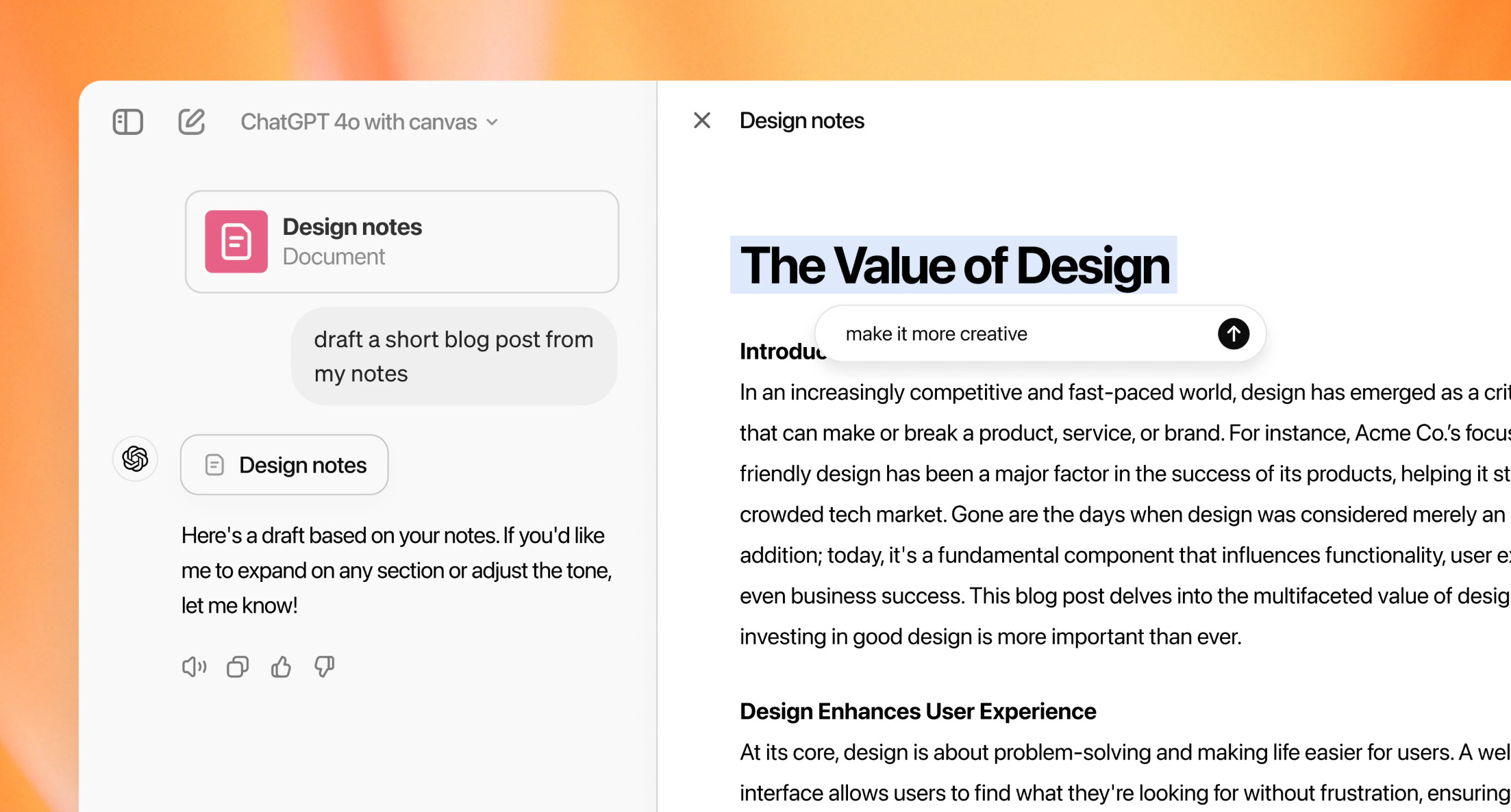
The output of v0 is not a paragraph in a chat thread. It is a working component that the user can manipulate. NotebookLM Audio Overviews produces an audio file that you can press play on. Claude Artifacts and OpenAI Canvas produce documents you edit in place. The chat, if it exists at all, is a side channel for revising the canvas. The canvas is the product. What the canvas eliminates is translation.
The Delegated Agent: AI Takes the Work and Reports Back
A delegated agent takes a task from the user and reports back when it has made progress or finished. The user is not in the loop on every step. They describe what they want at a moderate level of abstraction, hand it off, and check in later. The agent does the work in between.
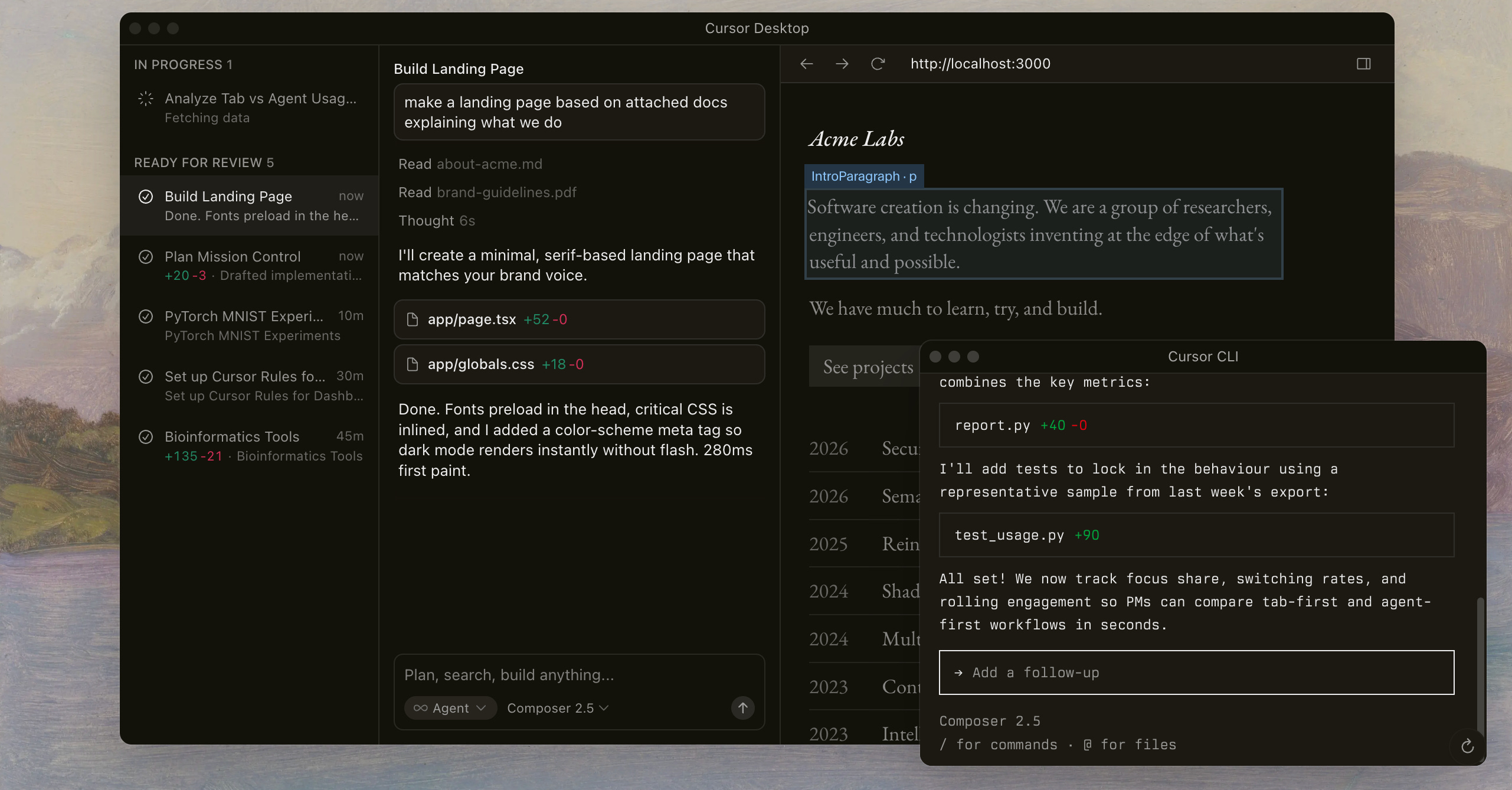
This is the freshest of the four patterns. People often miscategorize it as chat with longer responses, but it is not the same thing. Claude Code lives in the terminal. The user names a task at a moderate level of abstraction. The agent reads files, edits code, runs tests, and asks for help when it needs to. The artifact is the repository changing under the user’s hands.
OpenAI Codex runs the same idea asynchronously in a cloud sandbox and returns a pull request. OpenClaw is the orchestrated variant, a personal AI operating system of specialized agents built on top of Claude Code. What the delegated agent eliminates is supervision.
The Ambient Capture: AI Listens, the User Does Not Type
An ambient capture watches what the user is already doing and produces useful artifacts in the background. The user does not invoke the AI at all. The AI is paying attention to work the user was going to do anyway. It produces transcripts, summaries, calendar events, or action items as a byproduct.
Granola and Circleback record the meeting that was happening anyway and produce the notes as a byproduct. The WWDC screenshot tool watches what is already on screen and offers to lift events into the calendar. In both cases, the interface is the absence of an interface. What the ambient capture eliminates is the prompt itself.
The newer shape of this pattern is the always-on, on-device, local agent. It runs continuously in the background, on the user’s own machine rather than in the cloud. It watches calendar events, messages, screen activity, and ongoing tasks. When something important comes up, it routes the work to the right application without being asked. For instance,
A meeting reminder lands in the calendar.
A follow-up turns into a draft email.
A captured idea routes itself into a notes app.
The user does not switch between apps to align everything by hand. The local agent does the alignment as a continuous service, and the time saved compounds across every small decision the user no longer has to make.
Why Most Products Will Stay Stuck
Naming the four patterns is not the same as shipping them. There are real reasons most products will stay on the chatbox.
Chat is the politically safest interface a team can pick. It is how the team says yes to an exec's ask for AI while postponing the harder product decision about which user problem to solve. “Add a verb surface” is different. The team first has to agree on which verbs matter most to which user. That is strategy work, not feature work. Teams that cannot reach that agreement default to the work that does not require it.
Chat metrics also look like engagement. The PM’s weekly slide shows messages per user, session length, and daily active conversations, all trending up. All of these read as positive signals on a dashboard. The dashboard rewards adding chat. It does not directly punish, making the user pay the chat tax.
Chat also makes no specific promise. When chat produces a bad answer, the user blames themselves for asking incorrectly. When a verb surface fails, the user blames the product. That is why the WWDC keynote shipped a Siri chatbot app alongside the ambient features. The chatbot is the surface Apple could add without committing to a specific promise.
A Diagnostic for Whether Your Product Is Chat-Trapped
There are three questions worth answering tonight.
How often do users tell the product something it already knows?
If it is more than three in ten messages, you are making them repeat themselves.How many of your top ten use cases would survive if the chat box were removed?
Anything that survives belongs behind a verb, in a canvas, or in a delegation. Everything else is genuinely chat-shaped work.Could a new user finish a real job in under ninety seconds without typing a sentence?
If the answer is no, the chatbox is the bottleneck, not the model.
If two of three answers are red, the fix is not a better prompt template. It is a different surface entirely.
What This Means for the Next Two Years
Frontier models are converging. Anthropic, OpenAI, and Google can each handle most product jobs roughly as well as the others. This is true of small local models as well under 5-8gb in size. The small models for a dedicated task are as good as a large general model. So the choice between them stops mattering as much as it used to. What still matters is the interface the team wraps around the model.
The roles change, too. The most valuable hire in a 2026 product organization is the person who can decide which AI capability deserves a verb, which deserves a canvas, which deserves a delegation, and which should stay ambient. That role does not have a name yet. The naming will catch up soon enough.
The work ahead is simple. Stop shipping the chatbox. Start shipping the verb.