

TLDR: AI tools are collapsing traditional role boundaries—PMs build dashboards, engineers write copy, designers produce specs. This creates a "Mexican standoff" where old lanes no longer match daily work. The real risk isn't job loss; it's chaos from faster output without coherence. This post shows how to redesign roles around decision rights instead of job titles. You’ll learn a practical framework (Doer/Decider/Reviewer), four collaboration artifacts that prevent drift, and what PMs specifically should become. Read this if your team is shipping faster but feels misaligned, or if you're unsure how AI changes product management fundamentally.

The Collapse Is Real, And It’s Not About Job Loss
Picture a normal week. A PM uses Claude Code to produce a working internal dashboard that had been sitting in an engineering backlog. A designer ships a prototype that already includes the awkward states users hit in production. An engineer writes three copy variants while adjusting the UI component.

Marc Andreessen describes this friction as a “Mexican standoff” among PMs, designers, and engineers—the old lanes no longer align with the actual work.
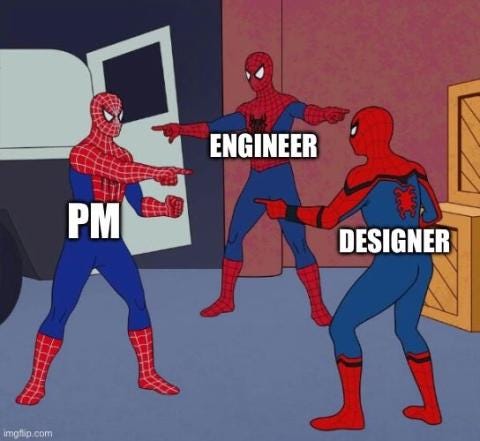
This is boundary collapse. Execution capability spreads across roles because AI tooling makes credible artifacts cheap to produce. Anyone can now build things that used to require specialized skills. The constraint shifts from who can make something to who can decide what should exist.
Which is why the term “job loss” misses what’s happening week to week. The near-term change is “task reshuffling.” Some tasks disappear, many get faster, and most get rebundled into new workflows and expectations. Work reorganizes around different constraints: decision rights, coherence, and accountability.

More output arrives first. Misalignment follows quietly.
This blog shows how to redesign roles around outcomes and decision rights.
What Exactly Is Collapsing
This section exists to make the blur legible. Without a simple map, teams argue about identity and titles. A clear map keeps the conversation on work, ownership, and outcomes. Here are the three areas where boundaries are collapsing.
PM and Engineer
Drafting specs that include edge cases and acceptance criteria so engineers can execute with less back-and-forth.
Producing a clickable demo or internal proof that narrows the scope before a build starts.
Turning raw customer feedback into a structured backlog that encodes tradeoffs and sequencing.
The PM now produces technical artifacts. The engineer now shapes product scope.
From Artifacts to Organisms: Supercharging Development with Claude Code's Agentic Context Engineering

Yesterday, I watched a new podcast from Lenny Rachitsky. The podcast interviewed Asha Sharma (CVP of AI Platform at Microsoft). One thing that fascinated me was that products are transitioning from artifacts to organisms because of AI agents. This idea made me research about this article.
Engineer and Designer
Writing multiple copy directions and microcopy variants while iterating on UI behavior.
Exploring interaction options and edge states fast enough that design intent and feasibility converge earlier.
The engineer now makes content decisions. The designer now navigates technical constraints.
Designer and PM
Synthesizing research notes into themes, risks, and decision-ready narratives.
Writing onboarding language and positioning that stays consistent with the product’s mental model.
The designer now structures strategic inputs. The PM now produces user-facing language.
The Hidden Failure Mode: More Throughput, Less Coherence
Here is how it breaks. Your onboarding flow promises "get set up in 5 minutes." Your pricing page emphasizes "enterprise-grade control." Your settings screen adopts a new toggle pattern in one section while keeping old dropdowns in another. Each decision was reasonable. But the composite is confusing.
Output rises immediately. Coherence degrades quietly. Coherence is consistency across:
UX patterns and interaction language,
Positioning and copy,
Metrics definitions and measurement,
Decision logic and constraints.
When more people can produce product artifacts quickly, local changes accumulate. You get onboarding that promises one thing while pricing implies another. You get settings that adopt new patterns in one area and old patterns in the rest. None of these are “bugs.” They are coordination debt.
Teresa Torres has been explicit about a related trap: delivery pressure can crowd out discovery discipline, and faster building can pull teams toward what is easy to produce rather than what is valuable to learn.
You can also predict the coordination tax with old software lessons: as contributors increase, communication paths multiply, and misalignment becomes a first-order cost.
So the scarce resource shifts. Execution gets cheaper. Decision clarity and product coherence become the limiting factors.
If coherence is not owned, the product becomes a collage.
Redesign The Contract Outcomes Interfaces Accountability
AI tools let more people create product artifacts—specs, prototypes, demos, copy. This only works if your org has clear rules for outcomes, decision rights, and accountability. Without that clarity, your product becomes whatever the last person to touch it decided it should be.
Let’s make this concrete first.
Say your outcome is activation for new workspace admins, which moves from 32% to 42% in 8 weeks.
Your constraints:
You cannot change core navigation.
You cannot add more than 2 new backend calls.
The brand requires keeping the existing voice.
Decision rights:
PM decides scope cuts if the timeline slips.
Designer decides which of the three onboarding approaches to emphasize.
Engineer decides whether to instrument activation via backend events or client-side tracking.
Artifacts you’ll produce:
Decision log entry explaining why you chose tutorial overlay over empty states.
System map showing the three critical activation moments where users drop off.
Tradeoff table showing you prioritized speed over visual polish.
Launch narrative positioning this as “faster time to value.”
That’s the contract in action. Here’s how to structure it for any outcome.
Start with outcomes. Outcomes are measurable, scoped, and tied to a segment. Keep them dual-sided with a user signal and a business signal.
Outcome examples:
Activation for new workspace admins moves from 32% to 42% in 8 weeks. User: Faster value realization | Business: Higher retention cohort.
Trial to paid conversion for the SMB persona improves by 3 points this quarter. User: Clearer value prop | Business: Revenue growth.
Support tickets tagged “confusing pricing” drop by 25% in 6 weeks. User: Better understanding | Business: Lower support costs.
Define interfaces next. Interfaces describe artifacts, not activities. This prevents “I’m doing discovery work” from becoming a catch-all for undefined contributions.
Interface by function:
PM produces a decision narrative, sequencing, and a tradeoff record.
Design produces an interaction spec, principles for consistency, and edge state intent.
Engineering produces constraints, system invariants, and feasibility boundaries.
These are the artifacts each role is uniquely positioned to create. When contribution happens outside these lanes, decision rights determine who approves the work.
Then set accountability. Each outcome needs one DRI (Directly Responsible Individual). Contributors can be many. Reviewers should be explicit.
The DRI model works because it separates decision authority from contribution. Many people can produce artifacts. Many people can provide input. But only one person decides whether the outcome is achieved and makes the final call when trade-offs conflict.
Use a simple contract template:
Outcome
[Metric, segment, timeframe]
Constraints
[UX invariants, technical invariants, brand and compliance constraints]
Decision rights
[Who decides scope, who decides UX tradeoffs, who decides system tradeoffs]
Artifacts
[Decision log entry, system map update, tradeoff table row, launch narrative]
Everyone can build; not everyone can decide.
Copyable contract statement
We will optimize for [OUTCOME: metric, segment, timeframe], within [CONSTRAINTS: UX/tech/brand limits]. The DRI [NAME] owns the decision. Contributors [NAMES] produce [ARTIFACTS: list]. Reviewers [NAMES] validate coherence and constraints before the product surface moves.
This contract only holds if it is enforced in writing. Verbal agreements decay the moment priorities shift or new people join. The artifacts from the next section make the contract real.
What PMs Should Become In This New World
The boundary collapse forces a career clarification. Execution is no longer the moat. The moat is judgment that other people can see and follow.
The PM job does not disappear. It gets narrower in definition and harder in standards. Here is what that means in practice.
PM as Coherence Architect
You own sequencing, narrative, and tradeoffs. This means you make parallel work feel like one release. When engineering ships three features in parallel, you write the launch narrative that ties them together. When design proposes a new interaction pattern, you check whether it conflicts with existing patterns. When someone updates copy, you verify it matches the product’s voice and mental model. You are the person who says “that does not belong here” and can explain why.
Example: Engineering ships a dashboard feature, a new API endpoint, and a billing update in the same sprint. Separately, they look like infrastructure work. Your job is to write the release narrative that positions them as “Enterprise-ready workspace controls” so customers see one coherent capability, not three unrelated updates.
PM as Systems Thinker
You understand constraints well enough to make realistic decisions. You should be able to read a system map and spot where tight coupling will create drag. You should be able to ask “what breaks if we add this?” and understand the answer. You should know the difference between a database constraint and a business rule well enough to know which one can flex under pressure.
Example: Design proposes a “duplicate workspace” feature. You check the system map and notice workspace creation is tied to billing events, which means duplication would trigger unexpected charges. You spot this before engineering starts building.
PM as Leverage Designer
You design workflows that scale decision-making across teams. You create decision templates that five teams can reuse without asking for clarification. You build artifact formats that capture why you decided X without requiring synchronous meetings. You set up review rituals that catch drift before users experience it.
The goal is not to make every decision yourself. The goal is to make good decisions repeatable and bad decisions impossible.
Example: You create a feature proposal template that includes outcome metric, constraints, three alternatives considered, and decision criteria. Now, when anyone proposes a feature, the conversation starts from tradeoffs rather than lobbying.
Capability Self-Check
Here is how to assess whether you are operating at this level:
I can write a one-paragraph tradeoff explanation that engineering, design, and execs accept as complete.
I can look at a system map and identify where coupling will create future drag.
I can design a decision artifact that five contributors can use without clarification.
The PM job is not disappearing. When execution is cheap, judgment becomes valuable—but only when it is visible, structured, and repeatable.
That is the new PM superpower: making decisions legible, coherence enforceable, and good judgment scalable across teams that move faster than org charts can keep up with.